
Quick answer: what are the side effects of tirzepatide?
The most common side effects are digestive: nausea, diarrhea, vomiting, and constipation. In the placebo-controlled weight-loss trials behind the Zepbound label, about 56% of people taking tirzepatide had a gastrointestinal reaction, compared with 30% on placebo. Most of these happened while the dose was being raised and faded over time. Less common but more serious problems include pancreatitis, gallbladder disease, kidney injury from dehydration, and severe allergic reactions. Tirzepatide also carries a boxed warning about thyroid C-cell tumors seen in rats. This article summarizes the current Zepbound prescribing information for research education. It is not medical advice.
Key Takeaways
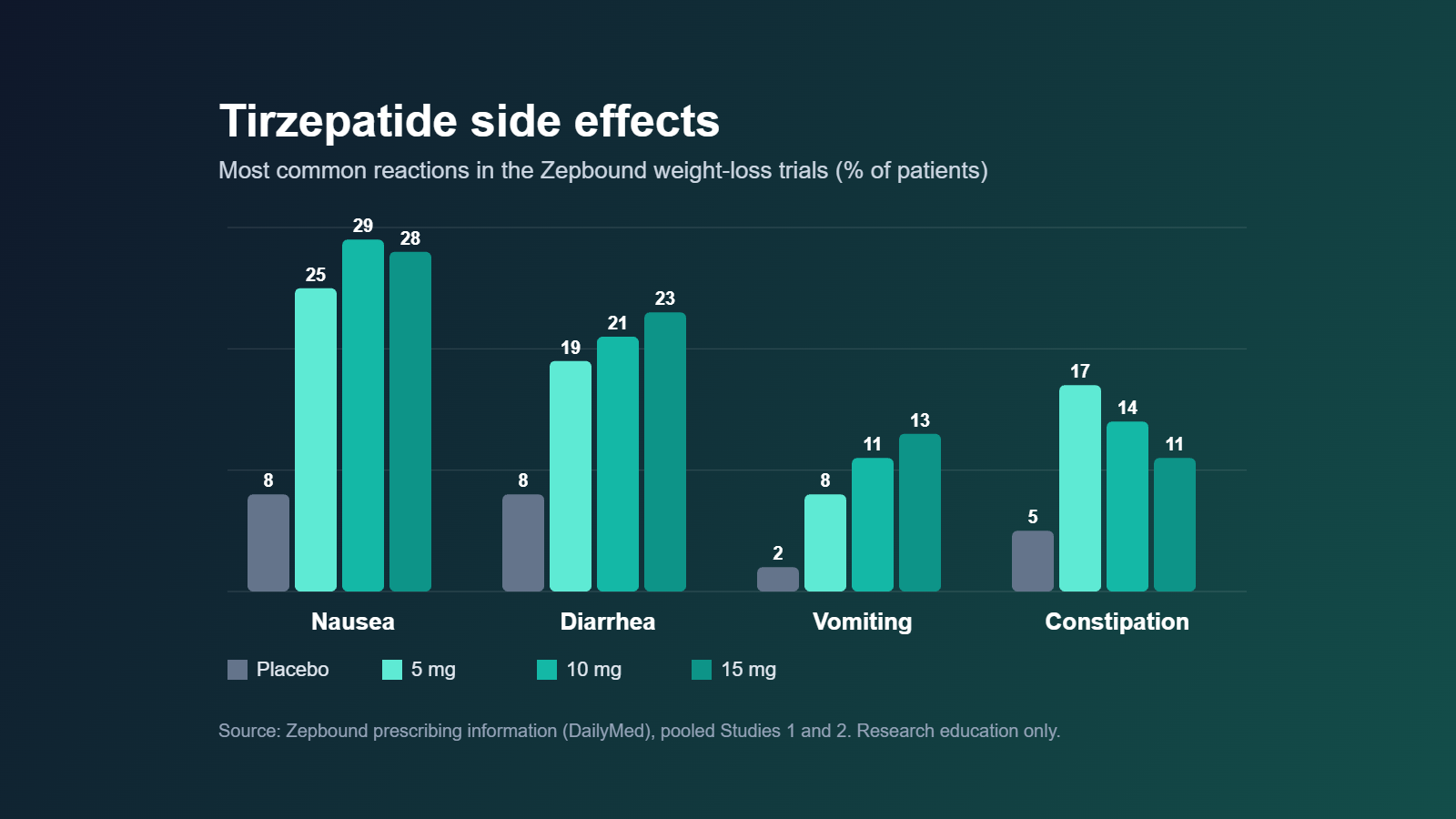
- In the pooled weight-loss trials, nausea affected 25% to 29% of people on tirzepatide versus 8% on placebo. Diarrhea affected 19% to 23% versus 8%.
- Most nausea, vomiting, and diarrhea happened during dose escalation and decreased over time.
- Gastrointestinal reasons caused 1.9% (5 mg), 3.3% (10 mg), and 4.3% (15 mg) of people to stop, versus 0.5% on placebo.
- Serious but less common risks include pancreatitis, gallbladder disease, kidney injury from dehydration, hypersensitivity, and low blood sugar when combined with insulin or sulfonylureas.
- The boxed warning concerns thyroid C-cell tumors in rodents. It is unknown whether tirzepatide causes them in humans.
- The drug can reduce the effect of oral birth control pills, especially after starting and after each dose increase.
The most common side effects, by the numbers
The label reports adverse reactions that occurred in at least 2% of people taking Zepbound and more often than with placebo. The table below uses the pooled results of Study 1 and Study 2, which together enrolled about 2,500 adults treated with tirzepatide for weight reduction. The percentages are for placebo, then the 5 mg, 10 mg, and 15 mg doses.

- Nausea: 8%, 25%, 29%, 28%
- Diarrhea: 8%, 19%, 21%, 23%
- Vomiting: 2%, 8%, 11%, 13%
- Constipation: 5%, 17%, 14%, 11%
- Abdominal pain: 5%, 9%, 9%, 10%
- Dyspepsia (indigestion): 4%, 9%, 9%, 10%
- Injection site reactions: 2%, 6%, 8%, 8%
- Fatigue: 3%, 5%, 6%, 7%
- Hair loss: 1%, 5%, 4%, 5%
- Dizziness: 2%, 4%, 5%, 4%
Notice that vomiting and diarrhea rise with the dose, while constipation was actually highest at the lowest dose. Other reactions listed included burping, acid reflux, gas, abdominal bloating, and a small number of cases of low blood pressure. If you are curious about the fatigue number specifically, we cover that in does tirzepatide make you tired.
What those percentages mean in plain English
At the 10 mg dose, 29% of people reported nausea, which is roughly 3 in 10. On placebo it was 8%, or about 1 in 12. So the extra nausea attributable to the drug is around 21 people per 100, not 29. The same logic applies to diarrhea, where the difference at 10 mg was 13 percentage points (21% versus 8%). Placebo groups report side effects too, which is a reminder that not every symptom in a trial is caused by the drug. It also means the true drug-related burden is the gap between the columns, not the raw number alone.
When do side effects happen, and do they go away?
The label states that most nausea, vomiting, and diarrhea occurred during dose escalation and decreased over time. That pattern is why the dose is raised in steps instead of starting at the full strength. Overall, 4.8%, 6.3%, and 6.7% of people on the 5 mg, 10 mg, and 15 mg doses permanently stopped treatment because of adverse reactions, compared with 3.4% on placebo. Most of those who stopped did so in the first few months, mainly because of digestive symptoms. In other words, most people stayed on treatment, but a meaningful minority did not tolerate it.
Less common but more serious risks
These are listed in the Warnings and Precautions section of the label. The rates below come from the same pooled weight-loss trials unless noted.
- Severe gastrointestinal reactions: reported in 1.7% (5 mg), 2.5% (10 mg), and 3.1% (15 mg) versus 1% on placebo. Tirzepatide is not recommended for people with severe gastroparesis.
- Acute kidney injury: there are postmarketing reports, sometimes requiring dialysis, mostly in people who became dehydrated from nausea, vomiting, or diarrhea.
- Gallbladder disease: cholecystitis occurred in 0.7% of tirzepatide patients versus 0.2% on placebo, and cholecystectomy in 0.2% versus none. The label notes these events were associated with weight loss.
- Pancreatitis: including fatal and non-fatal hemorrhagic or necrotizing forms, has been observed with GLP-1 drugs. Persistent severe abdominal pain, sometimes spreading to the back, is a warning sign.
- Hypersensitivity: severe reactions such as anaphylaxis and angioedema were reported in 0.1% of tirzepatide patients and none on placebo.
- Low blood sugar: in a trial of people with type 2 diabetes, hypoglycemia occurred in 4.2% versus 1.3% on placebo. It rose to 10.3% when combined with a sulfonylurea, versus 2.1% without one.
- Diabetic retinopathy: people with a history of it should be monitored for progression.
- Aspiration during anesthesia: reported with GLP-1 drugs in people having elective procedures, so surgeons and anesthesiologists need to know about use.

Do side effects differ in other conditions?
The label notes that rates of severe gastrointestinal reactions, gallstones, and severe hypersensitivity were similar in its trials in people with obstructive sleep apnea. Blood sugar effects look different in people with type 2 diabetes, where the risk of low blood sugar was higher, especially with sulfonylureas or insulin. In other words, the same drug can come with a somewhat different risk profile depending on who is taking it and what else they take.
The thyroid boxed warning, explained
Tirzepatide carries the strongest type of FDA warning because, in rats, it caused thyroid C-cell tumors at clinically relevant exposures, in a dose- and duration-dependent way. The label says it is unknown whether tirzepatide causes these tumors, including medullary thyroid carcinoma, in humans, because the human relevance of the rodent findings has not been determined. As a result, the drug is contraindicated in anyone with a personal or family history of medullary thyroid carcinoma or with Multiple Endocrine Neoplasia syndrome type 2. Rodent findings do not prove a human risk, but they are the reason for the caution.
Heart rate, birth control, and pregnancy
Treatment raised average heart rate by 1 to 3 beats per minute compared with no increase on placebo. Because tirzepatide delays stomach emptying, it can change how oral medications are absorbed. The label specifically says it may reduce the effectiveness of oral hormonal contraceptives, with the largest effect after the first dose, and advises switching to a non-oral method or adding a barrier method for 4 weeks after starting and after each dose escalation. The label also says it may cause fetal harm and should be stopped when pregnancy is recognized.
What about mood and suicidal thoughts?
Earlier Zepbound labeling included a warning about suicidal behavior and ideation. The label’s revision history now lists that warning as removed in February 2026. That does not mean mood changes are impossible, and anyone who notices a sharp change in mood should contact a clinician, but it is an example of why you should read the current label and not rely on older summaries.
How to read this information
- These figures come from the Zepbound weight-loss trials. The Mounjaro label for type 2 diabetes is separate and can differ in details.
- Trial populations are screened and monitored closely. Real-world rates may be different.
- Products sold as "research tirzepatide" or compounded versions are not covered by these trial results, and their purity and dose are not verified.
- Side effects can be reported to the FDA through MedWatch (1-800-FDA-1088 or http://www.fda.gov/medwatch).
Bottom line
Tirzepatide’s side effects are mostly digestive, dose-related, and strongest during the first months. The serious risks are uncommon but real, and several, such as dehydration, gallbladder trouble, and pancreatitis, can be recognized early if you know the warning signs. If you want the bigger picture, see our post on who takes tirzepatide. You can discuss the research in the forum. Please read our research disclaimer before posting. Nothing here is medical advice, and decisions about prescription drugs belong with a qualified clinician.
Leave a Reply